You have a clear task.
You know what needs to be done. You have the skills to do it.
And yet, somehow, your brain feels like it has stopped cooperating.
You reread the same email three times. A simple decision suddenly feels complicated. Your attention keeps drifting. And that cup of coffee on your desk starts looking more interesting than the presentation you’re supposed to be working on.
What if this isn’t a discipline problem? What if it’s a timing problem?
This is one of the ideas explored in Daniel H. Pink’s When: The Scientific Secrets of Perfect Timing, a book that challenges how we think about productivity at work.
We spend enormous amounts of time thinking about what we should work on and how we should work. We build productivity systems, download task-management apps, create to-do lists and attend workshops on time management.
But we rarely ask a much simpler question:
When should we be doing this work?
1. Your Energy Has a Rhythm
Our workdays often look like a straight line on the calendar.
9 AM meeting.
11 AM presentation.
1 PM lunch.
3 PM analysis.
5 PM brainstorming.
But our bodies don’t operate in straight lines.
We have an internal biological clock, known as the circadian rhythm, which influences our alertness, energy, sleepiness and cognitive performance throughout the day.
For many people, this creates a predictable pattern:
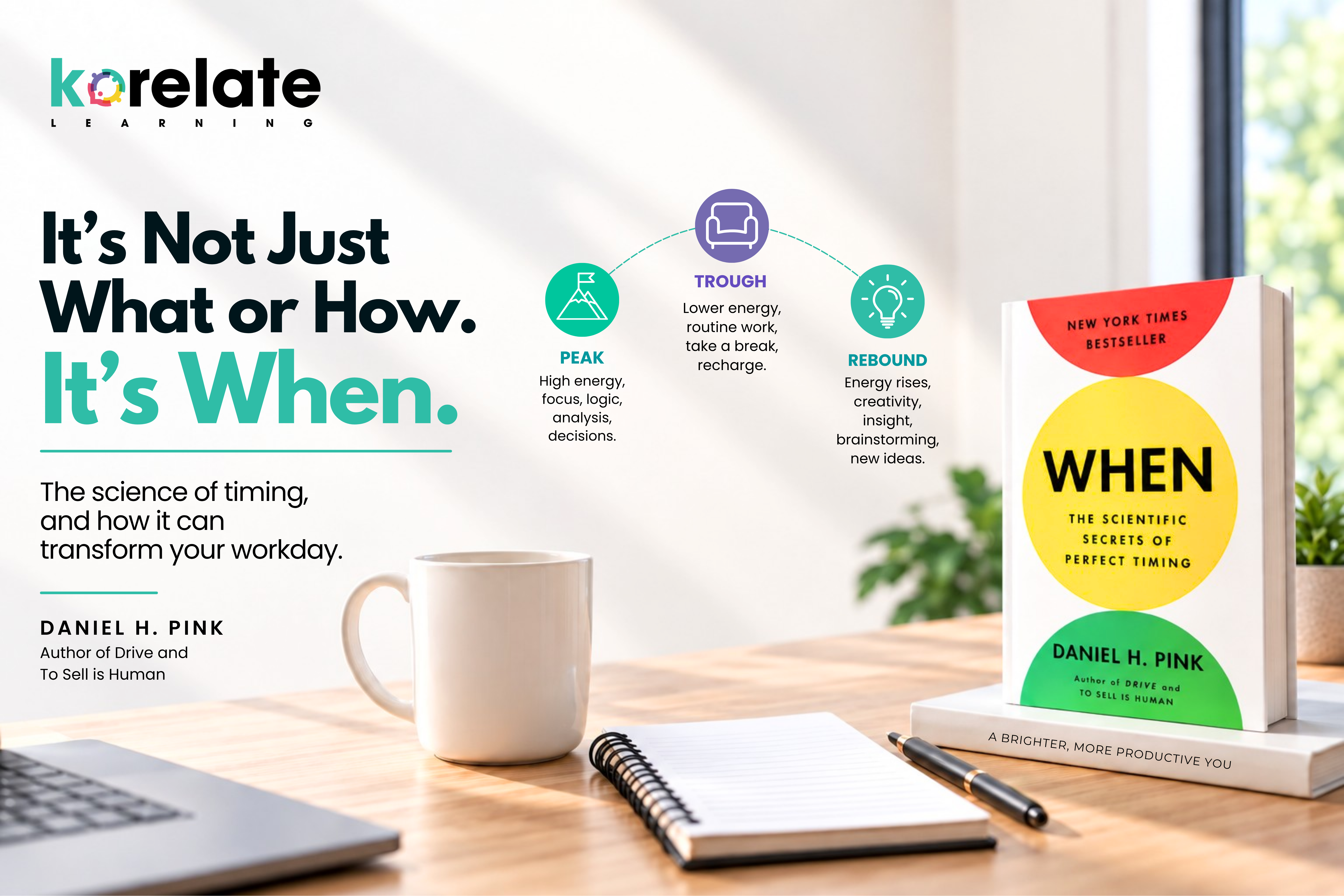
Peak → Trough → Rebound
Understanding this pattern can completely change how we structure our work.
2. The Peak: When Your Brain Is Sharpest
The Peak is the period when you’re most alert and focused.
This is when your brain is generally better suited for tasks that require logic, concentration and careful decision-making.
Think:
- Analysing data
- Planning projects
- Making important decisions
- Writing complex documents
- Solving problems
- Reviewing detailed information
The mistake many of us make is filling these valuable hours with low-effort work.
If your brain is at its sharpest, should that time really be spent clearing your inbox?
3. The Trough: Your Daily Productivity Dip
Then comes the Trough. For many people, this happens somewhere around 2 to 4 PM, roughly 7 to 8 hours after waking.
One survey cited by Pink identified approximately 2:55 PM as the point when people reported their lowest level of energy.
This is what we might call the body’s daily “Bermuda Triangle”.
It’s the period when focus can disappear, energy drops and even simple tasks can feel unnecessarily difficult.
Our biology is involved.
Research discussed in When highlights how performance can suffer during these periods. In high-stakes environments, the consequences can be significant. Doctors, for example, can be more prone to mistakes later in a long work period, while judges have been found to become less likely to grant parole as they continue working without a break.
Same professionals.
Same training. Same skills.
Different time of day.
That is a powerful reminder that performance isn’t just about capability. It’s also about timing.
4. The Rebound: When Creativity Can Return
After the Trough comes the Rebound.
Your energy begins to rise again, but something interesting happens: you may not necessarily return to your Peak level of focused attention.
Instead, you may become more relaxed and less constrained.
And that can be useful.
Tasks involving creativity, brainstorming and insight can benefit from this mental state.
This gives us an important distinction:
Your most focused time isn’t necessarily your most creative time.
The best time to analyse a problem may not be the best time to come up with a completely new solution.
5. There Is No "Perfect" Workday
Another key insight from When is that people have different chronotypes, or natural patterns of alertness.
Some people are Larks, who naturally feel more energetic and alert earlier in the day.
Others are Owls, who tend to come alive later.
But most people fall somewhere in between.
Pink calls this group Third Birds, and they make up roughly 80% of people.
This has an important implication for workplaces:
There is no single productivity schedule that works equally well for everyone.
The person who is ready to tackle a complex problem at 8 AM may not have the same experience as someone whose brain reaches its Peak later in the day.
Instead of asking, “What’s the best time to work?”
A better question might be:
“What’s the best time for me to do this type of work?”
6. What About That Afternoon Slump?
If the Trough is difficult to avoid, can we do anything about it?
Interestingly, When suggests that even a short break can make a meaningful difference.
A 10 to 20-minute nap around the beginning of your Trough can improve alertness and performance for several hours.
And there’s an unusual productivity hack that combines two things most workplaces already know well:
Coffee + a short nap.
Caffeine typically takes around 20 to 25 minutes to take effect.
So, in theory, drinking coffee immediately before a short nap means you can wake up around the time the caffeine begins working.
It’s not necessarily practical in every workplace, of course.
But the principle behind it is more important than the hack itself:
When performance drops, the answer isn’t always to push harder. Sometimes it’s to recover strategically.
7. Different Work Requires Different Mental States
This may be the most useful idea to take back to the workplace.
We often treat “work” as one category.
But checking a spreadsheet, making a strategic decision, facilitating a meeting and brainstorming a new idea all require different kinds of thinking.
So why should they all be scheduled in exactly the same way?
Consider a simple approach:
Type of work | Potentially better time |
Deep analysis | Peak |
Important decisions | Peak |
Planning | Peak |
Routine administration | Trough |
Emails & follow-ups | Trough |
Break / recovery | Trough |
Brainstorming | Rebound |
Creative problem-solving | Rebound |
Generating new ideas | Rebound |
This isn’t a rigid formula. It’s an experiment.
The goal is to understand your own energy patterns and see whether changing the timing of your work improves your performance.
8. What Can Leaders Do Differently?
The implications aren’t limited to individual productivity.
There is also a lesson here for how we design workplaces.
If every important discussion happens at 4 PM, every employee is expected to be equally productive at every hour, and meetings occupy the periods when people are naturally most focused, we may be designing our workdays around the clock rather than around people.
The goal isn’t to create a workplace where everyone takes naps at 3 PM.
It’s to create a workplace that recognises a simple truth:
People aren’t machines.
9. And Then There Are Endings
One final idea from When stood out to me.
Endings have a strange ability to motivate us.
A deadline approaches.
A project enters its final week.
The year comes to an end.
A milestone birthday arrives.
Suddenly, things that we’ve been putting off become urgent.
Pink discusses what’s sometimes called the “9-ending effect.” People are disproportionately likely to take action around ages such as 29, 39 or 49, including starting their first marathon.
Why?
Because milestones make us stop and evaluate where we are. They create a psychological boundary between where we’ve been and where we’re going.
We can use this at work too.
Instead of relying entirely on motivation, create meaningful milestones. Don’t just say: “We’ll get this done eventually.”
Create a clear finish line. “By Friday, we’ll have the first version ready.” Sometimes, a visible ending is exactly what we need to get moving.
10. The Bigger Lesson: Work With Your Biology
The most valuable lesson I took from When isn’t that everyone should start work at a particular time or take a coffee nap every afternoon.
It’s much simpler than that.
Pay attention to your energy.
Notice when you’re at your sharpest.
Notice when your concentration drops.
Notice when ideas come more easily.
Then start matching your work to those patterns.
Because productivity isn’t simply about managing your time.
It’s about managing your energy, attention and timing within that time.
At Korelate Learning, we spend a lot of time thinking about how people learn, collaborate and perform better at work. When added another layer to that conversation for me.
Maybe the question we need to ask isn’t just: “What should we do today?”
Maybe it’s: “When is the right time to do it?”
Because sometimes, becoming more productive doesn’t require us to work harder.
It simply requires us to work at the right time

Kayden Coelho is a Co-Facilitator at Korelate Learning, known for his calm, dependable nature and effortless warmth. Always ready to lend a hand, Kayden brings steadiness and positivity to every task, ensuring that operations run smoothly and teams feel supported. His reliability and composed presence make him a true anchor within the team. Beyond work, Kayden’s love for dance and football keeps his energy high and his spirit grounded. Whether he’s moving to a beat or playing on the field, he embodies focus, rhythm, and teamwork. With his balanced mix of discipline and creativity, Kayden continues to make a quiet yet powerful impact at Korelate Learning — both as a teammate and as a person who inspires trust and connection.