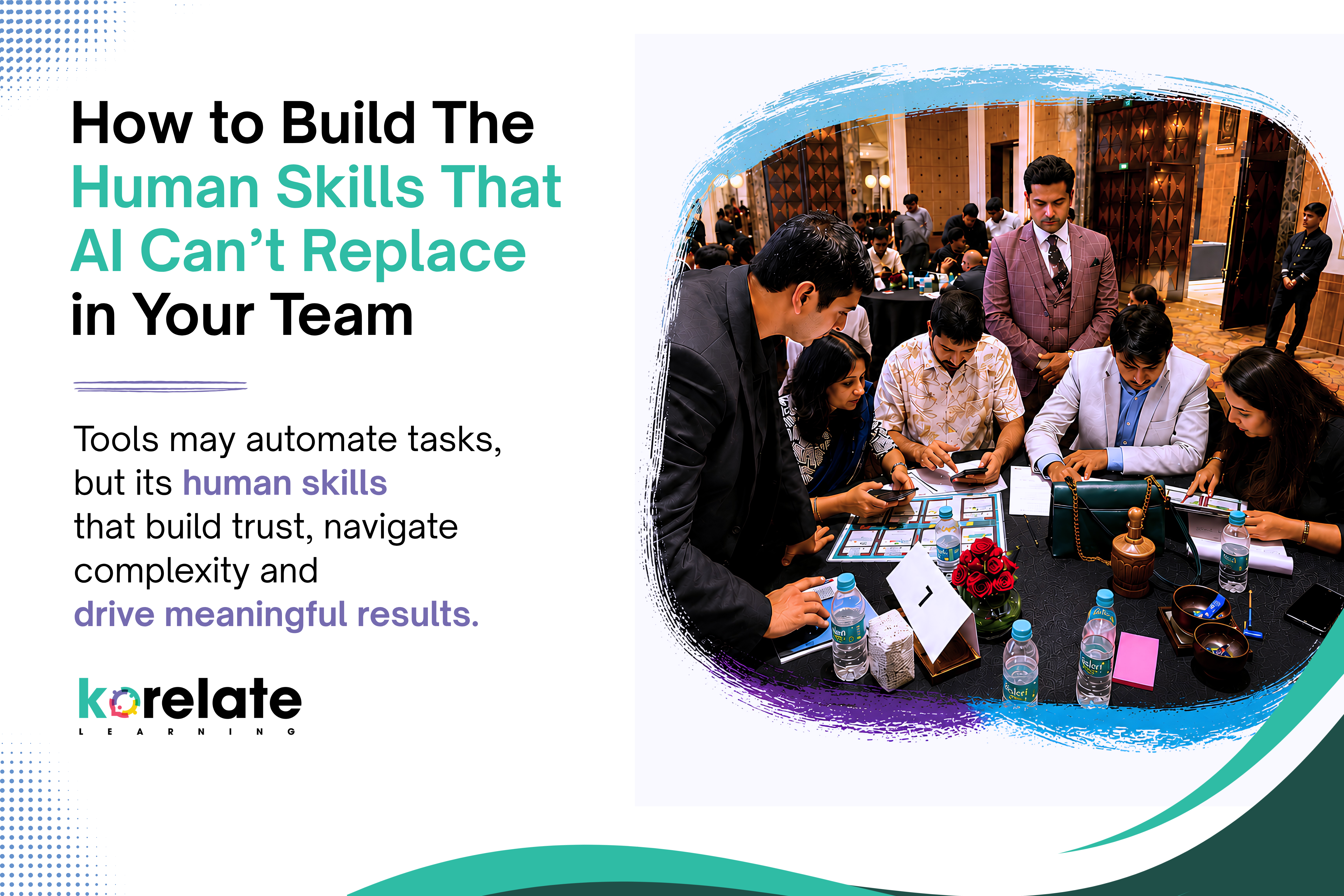
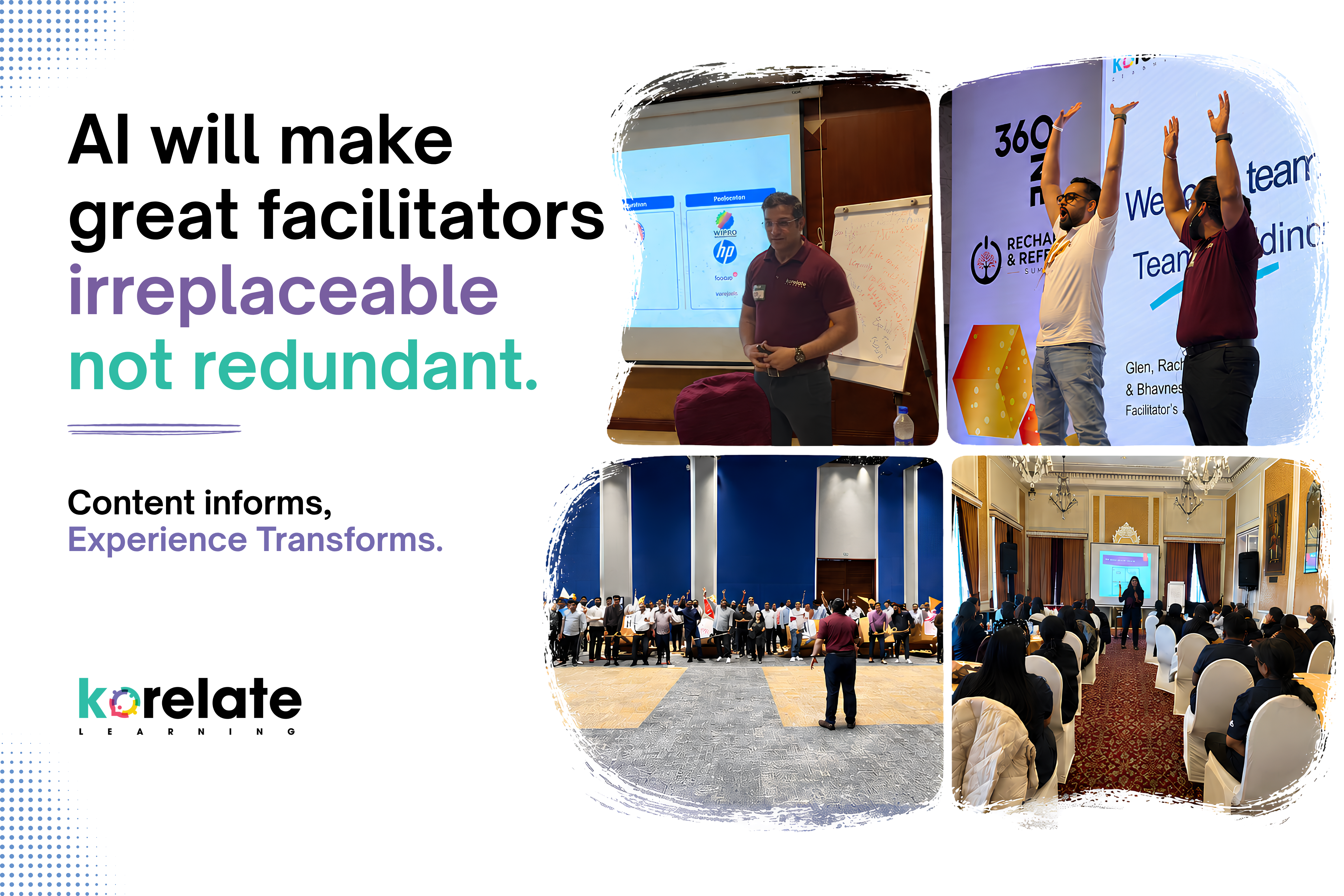
As AI floods the training industry with machine-made content, the hunger for genuine human connection, trust, and felt experience will intensify. The facilitator becomes the product.
The core paradox
What AI can now do
Generate training decks, quizzes, simulations, and scripts in minutes. Personalise content at scale. Deliver asynchronously across 100 countries.
What AI cannot do
Read the room. Hold silence after a hard question. Build psychological safety between strangers. Make a team feel seen, heard, and changed.
“Content is now table stakes. Experience is the differentiator. The facilitator’s job is not to transfer information — it is to create the conditions in which transformation becomes possible.”
The emerging consensus across L&D, OD, and team effectiveness research
Four reasons team connection intensifies in an AI world
1. AI creates isolation at scale
When individuals work with AI agents instead of each other, ambient belonging drops. Teams stop bumping into each other. Offsites and connects become the rare site of genuine encounter — not a perk, but a corrective.
2. Trust becomes harder — and more critical
AI-mediated communication strips out tone, body language, and presence. Teams that do not periodically meet in human space accumulate trust deficits. A single well-facilitated offsite can repair months of friction.
3. AI content raises the delivery bar
When every organisation has access to world-class AI-written modules, the bottleneck shifts to delivery. A mediocre facilitator with great content fails. A great facilitator with average content succeeds. Delivery skill is now the margin.
4. Humans crave meaning more, not less
When routine cognitive work goes to AI, employees are left with questions: what is my contribution? Do I matter here? Meaningful group experiences — rituals, shared challenges, celebrated wins — answer those questions. No algorithm can.
Where the market is heading, a near-term trajectory
Now (2026): AI floods content, delivery quality varies wildly
HR BPs produce content using AI tools. Sessions are delivered with variable quality. Clients notice the gap between polished decks and flat facilitation. The market starts rewarding delivery skill explicitly.
2026–2027: Experiential learning becomes a premium category
Organisations split budgets: AI handles asynchronous learning at scale; human facilitators own high-stakes, high-trust moments — leadership offsites, new team formation, conflict resolution, culture interventions.
2027–2028: Facilitator as strategic advisor
The best facilitators are no longer “trainers.” They are organisational diagnosticians who design experiences that shift culture, accelerate trust, and align teams around strategy. Day rates reflect this positioning.
2029–2030: Human facilitation as a scarce, high-value asset
As AI handles 80% of learning content delivery, the 20% that requires human presence commands a disproportionate share of attention, budget, and reputation. The scarcity premium is real.
The spectrum of learning modalities — where AI wins vs. where humans win
AI-led a sync learning — Modules, microlearning, compliance, skills drills
Hybrid: AI content + human delivery — Workshops, leadership programmes, coaching
Human-only: presence is the product — Offsites, team connects, culture interventions
What makes a great facilitator irreplaceable in this world
- Presence that settles a room
- Holding productive tension
- Reading unspoken dynamics
- Making dissent feel safe
- Adaptive design on the fly
- Creating shared meaning
- Emotional attunement
- Ritualising team identity
- Navigating power & hierarchy
- Embodied storytelling
Where to focus your positioning
The single most important move available to facilitators and team engagement professionals right now is a reframe, not a rebrand. Stop positioning yourself as a vendor of events. Start positioning yourself as the person who builds the human infrastructure that AI-first organisations are quietly losing.
Positioning
The old language “team building,” “morale,” “engagement activities” places you in a commodity market where every HR manager has a shortlist and a default answer of “we can do this internally.” The new language connects your work to a business-critical problem that AI has made urgent: the slow erosion of trust, belonging, and psychological safety in organisations that have optimised for efficiency over connection. That is not a soft concern. It is a retention, innovation, and performance risk that sits squarely on the CHRO’s agenda.
Facilitator skills
As AI commoditises content, the capability stack that cannot be replicated becomes your primary asset. Presence, attunement, adaptive design, the ability to hold a room through difficulty these are not soft skills. They are rare, high-leverage competencies that produce outcomes no AI tool can guarantee. Invest in developing and articulating them explicitly. The facilitators who thrive in the next five years will not be the ones with the best slide decks. They will be the ones who can walk into a room of strangers, read what is really happening, and create the conditions for something genuine to emerge.
Experience design
Offsites and team connects are no longer events on a calendar. In an AI-first world, they are maintenance cycles for human infrastructure — the periodic, intentional investments that prevent trust from eroding, meaning from going missing, and people from quietly disengaging. A well-designed connect does not just create a good day. It leaves a residue: shared language, new rituals, restored relationships, and a clearer sense of what this team is actually for. That residue travels back into the daily AI-assisted workflow and sustains the collaboration that no tool can manufacture.
AI will not replace great facilitators. It will make them more necessary, more visible, and for those who position themselves correctly more valuable than they have ever been. The organisations that understand this first will have a genuine advantage. The facilitators who claim this ground now will own it.

Siddharth is the Co-Founder of Korelate Learning, where he designs experiential learning programs that go beyond fun to build trust, leadership, and alignment within teams. With over 14 years in the L&D space—across facilitation, business development, and leadership—he brings deep expertise in purpose-led team building, MBTI-based psychometrics, and customized leadership journeys.