I didn’t set out to lead a young team. It just happened. And somewhere between my first hire and my fifteenth, I realised the leadership playbook I had inherited didn’t quite fit anymore.
Clients come to us with a version of the same problem: “We can’t figure out how to manage Gen Z.” Leaders are frustrated. Young employees feel disconnected. Everyone is convinced the other side doesn’t get it.
I nod along. And then I think, I run a company where most of my team hasn’t hit 26 yet. I’m not observing this from client’s perspective. I’m in it, every single day.
So let me share what I’ve actually learned, not from a whitepaper, but from the meetings, the 1:1s, the feedback sessions that went sideways, and the ones that didn’t.
The gap isn't about age. It's about assumptions.
Here’s what I used to believe: if someone on my team seemed disengaged, they needed to work harder. If they pushed back on a decision, they were being difficult. If they wanted to know the “why” behind everything, they were overthinking it.
All of that was wrong.
The people I work with didn’t grow up in a world where you trusted authority first and asked questions later. They grew up with Google. With Twitter that fact-check everything. With workplaces through internships, gig work, side projects, that broke their trust before they even joined full-time.
“They’re not questioning you because they think you’re incompetent. They’re questioning you because they were never taught not to. That’s actually a feature, not a bug.”
What they actually want (it's simpler than you think)
I’m going to skip the jargon. Here’s what I’ve observed, plain and simple:
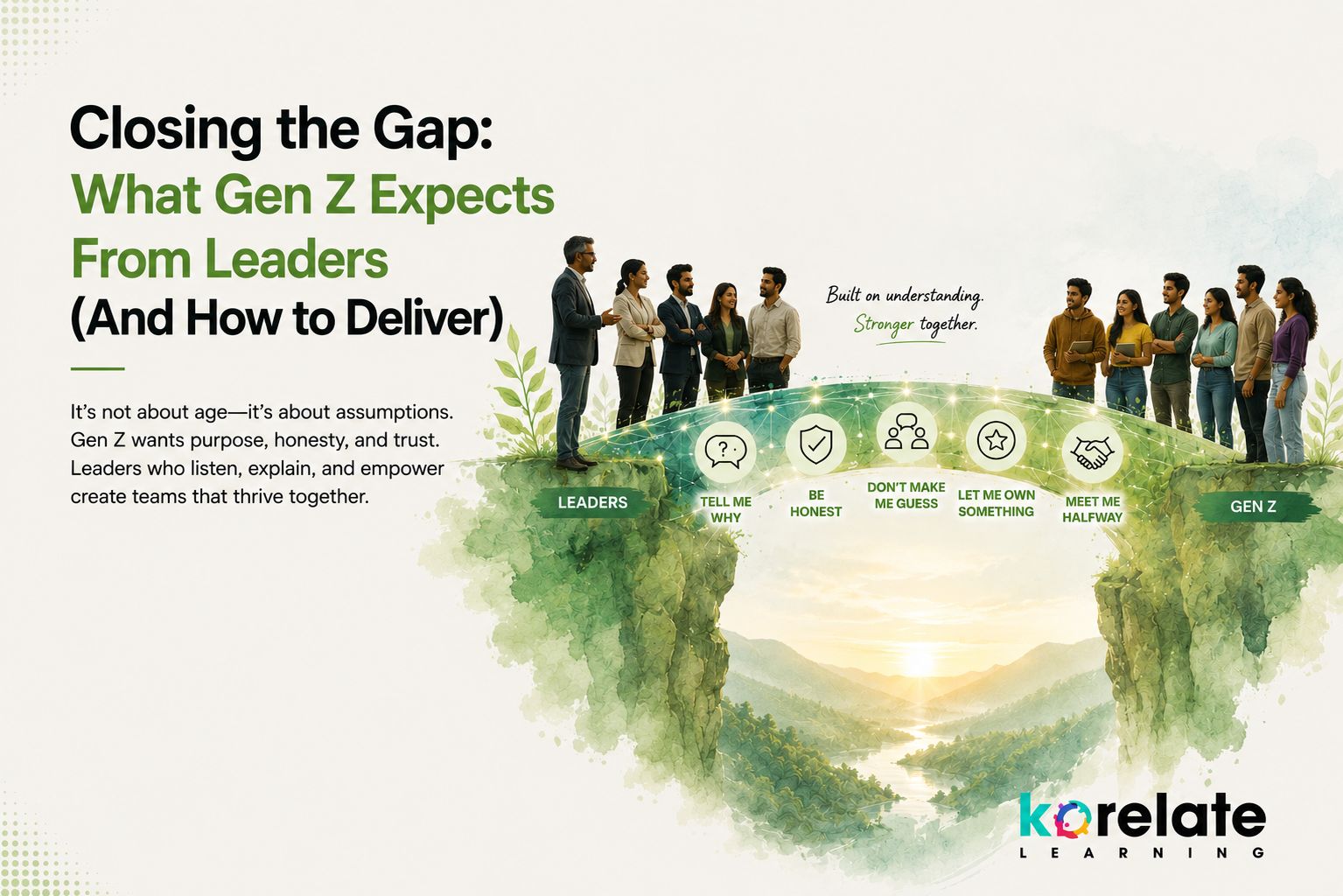
- Tell me why, not just what
- Be honest when things are uncertain
- Don’t make me read your mind
- Let me own something real
None of these are unreasonable. None of them are “entitled.” They are just expectations that were never verbalised in older work cultures, so we mistook their absence for acceptance.
The thing I had to wrap my head around: a 24-year-old who asks “why are we doing this?” isn’t undermining you. She is trying to do the work better. Give them a real answer and watch what happens.
I was Gen Z when I became a manager. I still didn't get it.
Here is the part that usually surprises people when I say it out loud.
When I moved from being an individual contributor to a manager, I was Gen Z myself. By age, by mindset, by everything. And yet I was just as guilty of the same blind spots I now see in senior leaders twice my age.
I had a clean line between personal and professional. Work was work. Life was life. When someone on my team seemed off, or brought something personal into a conversation, my honest internal reaction was: why are you bringing this here? Sort it out, show up, do the job.
I thought that was professionalism. I thought I was being fair, treating everyone the same, keeping things clean, not getting involved in things that weren’t my business.
I was wrong about what fairness actually looks like.
What changed things wasn’t a training or a book. It was just time, and paying closer attention. The more I actually got to know the people I was working with, the more I realised how much context I had been missing.
Someone who seemed unmotivated was dealing with something at home that made showing up feel enormous. Someone who appeared checked out had no idea whether their work actually mattered to anyone. Someone who kept missing the mark wasn’t careless they were lost, and too uncertain of the environment to say so.
It sounds obvious when you write it down. It wasn’t obvious to me at all when I was doing it wrong. I had to see the difference between a team that functioned and a team that actually trusted me before I understood what had been missing.
You don’t need to be a therapist. You don’t need to blur every boundary. You just need to be interested genuinely, not performatively. Know what someone is working toward. Remember what they told you last time. Ask a follow-up question. That’s it. That’s most of it.
Things I stopped doing (and what I do instead)
Stopped: Saving feedback for quarterly reviews.
Started: Saying it in the moment, good and bad, within the same week it happened.
Stopped: Announcing decisions from the top without context.
Started: Explaining the thinking, even when the decision was already made. “Here’s where we landed and here’s why” goes a long way.
Stopped: Treating every unconventional question as a challenge to authority.
Started: Getting curious about it. Half the time, the question surfaces something I hadn’t considered.
The part no one talks about: they have to meet you halfway
This is where I will say something that might not be popular.
I’ve put a lot of effort into adapting my leadership style. But adaptation works both ways. There are things I expect from everyone on my team, regardless of age:
- Follow through on what you said you’d do
- Raise problems early, not after deadline
- Disagree in the room, not in the group chat after
- Own your mistakes without spiralling
These aren’t generational values. They’re professional ones. And honestly, I’ve had to get better at them myself. The difference is I say it out loud now. I name the norms, explain why they matter to how we work, and I hold myself to them visibly so it’s not “do as I say,” it’s “this is how we all operate here.”
“Creating a culture where age gap isn’t a problem doesn’t mean pretending there’s no gap. It means making the gap irrelevant to how decisions get made and how people get heard.”
What actually closes the gap
Not a workshop. Not a policy. Not a keynote about “bridging generations.”
What closes the gap is repetition of small, honest moments. The 1:1 where you actually listen instead of preparing your next point. The time you say “I don’t know yet, let me think about it” instead of projecting confidence you don’t have.
Age stops being a friction point when people of any age feel that the environment is fair, that effort is visible, and that the person leading them is being straight with them.
I’m not a perfect leader. My team would tell you that, and I’d agree. But the one thing I’ve gotten right is refusing to treat the age gap as a problem to be managed. Instead, I treat it as information about what I need to say more clearly, what I need to explain better, and where I need to get out of the way entirely.
If you’re a leader struggling with this, I’d genuinely say: start smaller than you think. One honest conversation. One decision explained properly. One piece of feedback given before it’s too late.
That’s where it starts. Not in a framework. Not in a training room. In the ordinary moments that your team is watching more closely than you realise.

Siddharth is the Co-Founder of Korelate Learning, where he designs experiential learning programs that go beyond fun to build trust, leadership, and alignment within teams. With over 14 years in the L&D space—across facilitation, business development, and leadership—he brings deep expertise in purpose-led team building, MBTI-based psychometrics, and customized leadership journeys.