When I got tagged to run our 5-day “Campus to Corporate” program for the fourth year in a row, my first thought was: why me, again? I’d already run it three times. I figured I’d hit a wall, learning-wise, and wanted someone new on the team to take over so I could grow elsewhere. I was thinking about it purely as a task to check off.
Turns out I was wrong. My manager saw something I didn’t: this was actually my step up to Lead Facilitator. Instead of just running the sessions, I was now co-writing workbooks, pitching new activities, and facilitating live. That shift changed the whole week for me. It became a real refresher on things like personal branding, reading a room, thinking on my feet, and putting the customer first.
That got me thinking about something bigger — why most companies get employee training wrong, and why the usual approach just doesn’t stick.
The engine behind effective training workshops: Experience → Absorb → Reflect → Apply
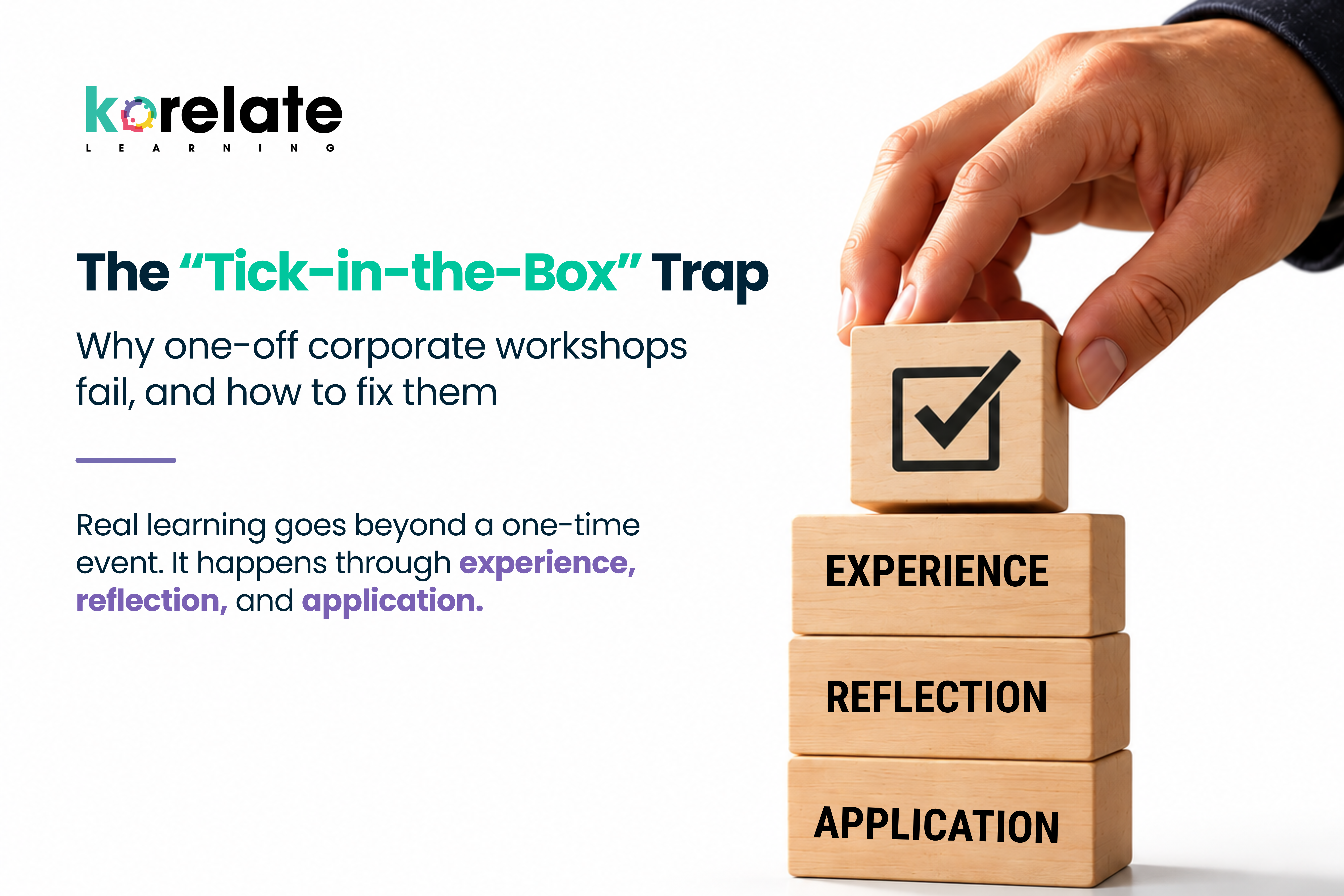
The reason a training and employee induction program like Campus to Corporate actually changes behavior — instead of just giving people a fun week — comes down to one simple loop: Experience, Absorb, Reflect, Apply.
Experience: No lectures, no slide decks people zone out on. Participants get thrown straight into individual and team activities and simulations where what they do actually has consequences.
Absorb: Because they’re doing it, not just hearing about it, things like teamwork, adaptability, and resilience sink in faster than any lecture could manage.
Reflect: Then comes the debrief — a chance to slow down, look at what just happened, spot their own blind spots, and figure out why something worked or didn’t.
Apply: Finally, they connect what they just learned back to their actual job — turning a lesson from a workshop into something they can use on Monday morning.
Why this approach to training & learning actually works
Most corporate training is still stuck in “information dump” mode — just telling people what to do. But people don’t change their behavior because of a slide. The Experience → Absorb → Reflect → Apply loop works because it’s built on how people actually learn:
It replaces being told with figuring it out. When someone learns something themselves, through their own experience, they own it. They’re not following a rule someone else handed them; they’re acting on something they discovered.
It sticks because it’s felt, not just heard. People forget what they were told pretty quickly. But they remember how it felt to be in a tense team exercise, or to mess something up in front of their peers.
It turns an activity into something useful. Reflection is what makes the difference. Without it, an activity is just a game. With it, that same activity becomes a lesson they can actually carry into their job.
Why "Campus to Corporate" training needs to happen every year, not once
A lot of companies treat experiential learning programs like this as a one-time thing — run the workshop, check the box, move on. But building real capability in people isn’t a one-time event. It needs to happen again and again.
1. It closes the gap between college and the real workplace
Fresh graduates come in talented, but doing well in school doesn’t automatically prepare you for a job. School rewards individual results. Work rewards teamwork. Programs like this help new hires rewire how they operate — from “me” to “we” — teaching them accountability, workplace etiquette, and how to work across different personalities and cultures.
2. It fights the forgetting curve
People forget most of what they learn within a few weeks if nobody reinforces it — studies suggest up to 75%. Skills like emotional intelligence, problem-solving, and resilience are like muscles. Without regular use, people slip back into old habits, especially once the daily grind kicks in.
3. It protects your investment in your people
A lot of early attrition happens because new hires feel lost or out of place in their first year. Give them a structured, hands-on experience like this, and you cut down that early friction, build trust faster, and get them contributing sooner.
4. It hits differently depending on where someone is in their career
Going through the same core ideas year after year isn’t repetitive — it actually lands differently each time. What someone takes away from a training session on growth mindset in year one is nothing like what they take away in year four, once they’re stepping into a leadership role. I saw this happen in my own journey — the same foundational ideas, but a completely different level of insight each time.
Stop treating training like a checkbox
If companies actually want strong, adaptable teams, they need to stop treating training like a one-time event. Leadership, empathy, and doing your job well aren’t things you learn once and keep forever — they’re things you have to keep practicing.

Meet Styren Dsouza, fondly called Sty, a lively Co-Facilitator at Korelate Learning, who started his journey at Korelate during its initial months. At only 22, Sty is like a fully changed bunny, hopping from one thing to the other with endless enthusiasm.With consecutive “Kore Star” under his kitty and being referred to as “Enthu Cutlet” by his team members, Sty is also a team player and thrives in a collaborative environment. Always ready to help his team members.