Before we design any workshop for you, we do something that surprises a lot of people. We ask a lot of questions.
And I don’t mean the logistical ones- how many people, indoor or outdoor, what’s the date. Those come later. I mean the uncomfortable ones. The ones that make HR managers pause and say, “Hmm, I hadn’t thought about sharing that.”
“Is this team actually gelling, or just being polite? Did someone new join and shift the dynamic? Is there a big deadline coming that’s making everyone anxious? What happened last quarter that nobody’s fully moved on from?”
That context is everything to us. It’s the difference between a workshop that feels good in the moment and one that actually moves something.
The problem with "just make it fun"
Here’s something I’ve noticed over the years, especially with team building. When clients come to us for a leadership workshop or a campus-to-corporate program, they come prepared. They share challenges, they talk about where their people are struggling, they’re invested in outcomes.
But team building? Often the brief is: “We have 80 people, we want something fun, maybe outdoors, post-lunch.” And that’s it.
I get it. The industry has trained everyone to think that team building is essentially a fun day out. A reward. A break from work. And sure, there’s nothing wrong with a fun day out — people need that too. But when you design an experience with only fun as the outcome, you leave so much on the table.
Because here’s the thing — fun is actually the best environment for real learning. People are relaxed, their guard is down, they’re playing. That’s exactly when behaviour shows up most honestly. That’s when you see who steps up, who goes quiet, who takes over, who waits to be told what to do. The activity is almost like a live case study of your team’s actual dynamics.
But you can only use that moment well if you knew what you were looking for before you walked in.
What our preparation actually looks like
Our facilitators are, honestly, a little obsessive about this part. Before any session, we want to understand the team well enough that when we are standing in the room, we are not running a generic program, we are responding to the specific human beings in front of us.
We ask about the team’s history. How long have they worked together? What have they been through recently? We ask about the manager’s style and how the team feels about it. We ask what success looks like six months from now — not for the workshop, but for the team. And then we work backwards from there.
A real example: we once worked with a sales team that was hitting their individual numbers but missing team targets. Their manager told us, almost as an aside, that they were a highly competitive group and that the internal competition had started to hurt collaboration. That one insight completely changed how we designed the day. Every activity we ran could only be won as a team, individual heroics actually pulled the group back. The debrief wasn’t just about what happened in the activity. People started connecting the dots to what was happening at work. That’s the conversation you want.
None of that would have happened if we had just shown up with a standard fun outdoor program.
Why the "Apply" stage is our obsession
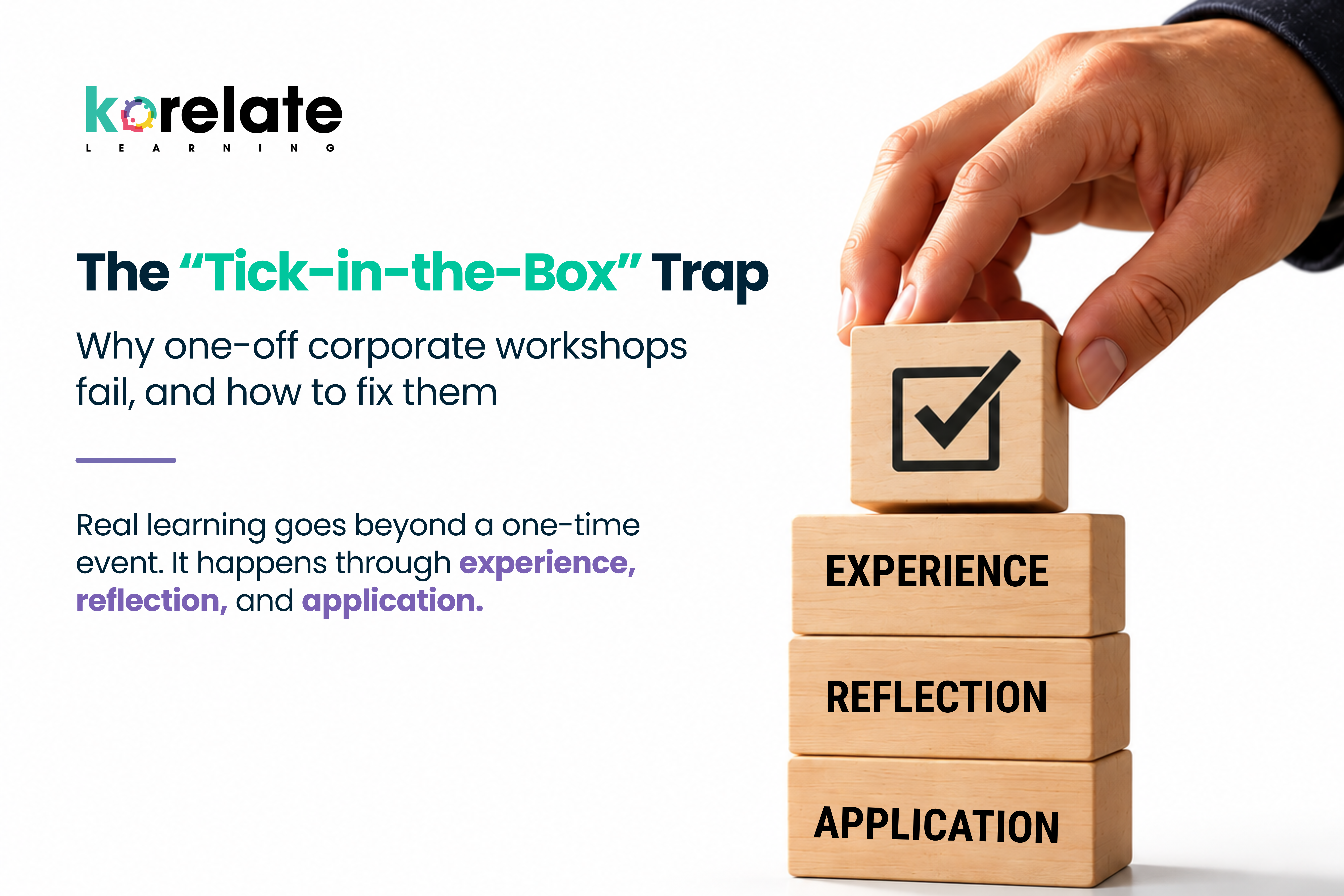
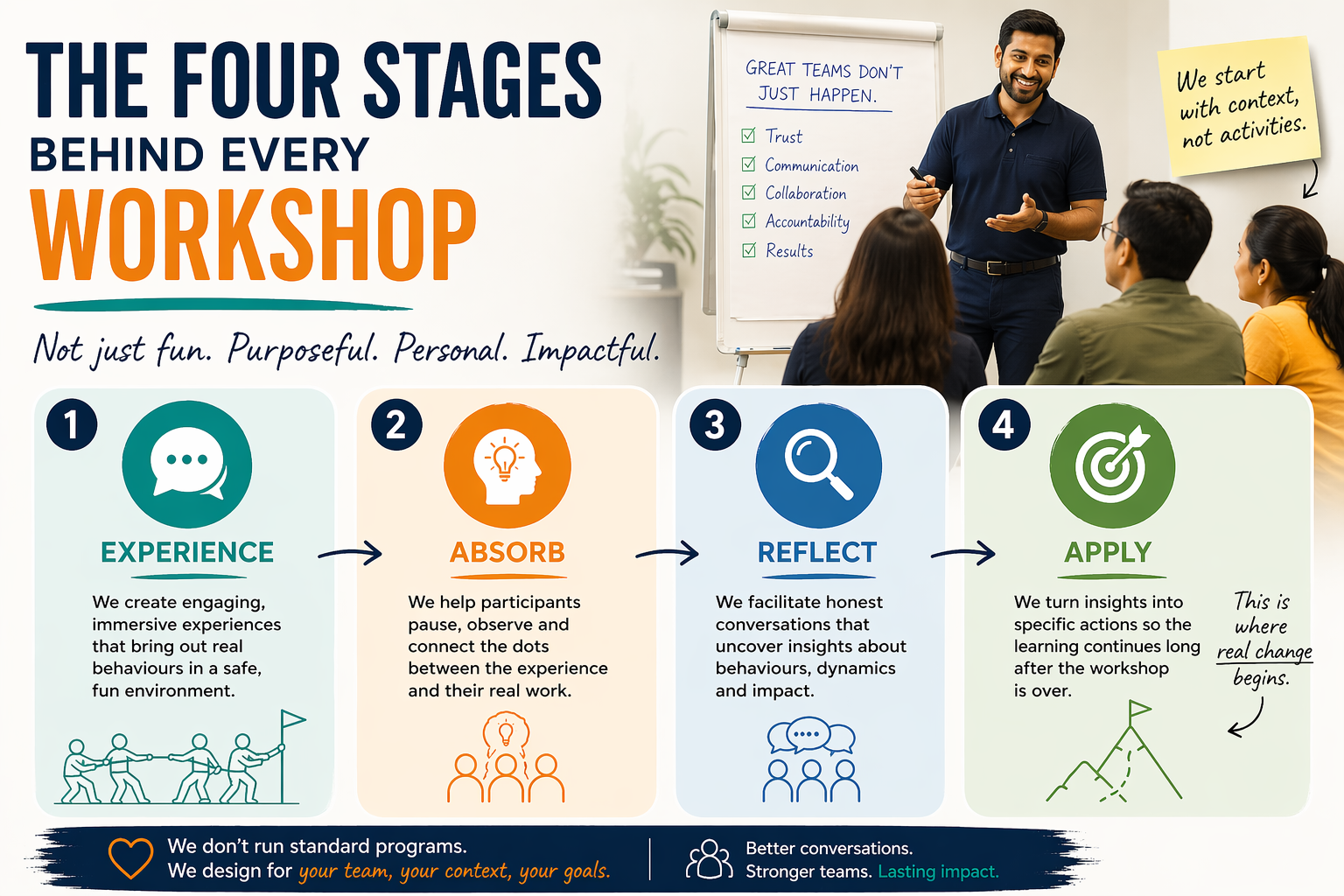
We have a learning framework we work with — Experience, Absorb, Reflect, Apply. Most experiential programs are good at the first three. You do something, you notice what happened, you reflect on it. That’s valuable.
But Apply is where we put our energy. Because what’s the point of a great reflection if people walk out of the room and nothing changes on Monday morning?
The Apply stage is where our facilitators earn their place. It’s not just asking “so what will you do differently?” It’s having designed the entire experience so that the insights participants arrive at are specific enough, personal enough, and relevant enough to their actual work that they can name a concrete next step. Sometimes it’s a conversation a manager commits to having. Sometimes it’s a team agreeing on a new way to handle conflict. Sometimes it’s something smaller, a shift in how someone sees a colleague they had written off.
But it doesn’t happen by accident. It happens because we spent time before the workshop understanding what needed to shift.
A plea to HR leaders
If you’re planning a team building session and you’re thinking of sharing minimal context because, well, it’s just a fun activity, we would love to change your mind.
Tell us what’s going on. Tell us the awkward stuff. The team that has been siloed for two years. The new leader who is not landing well. The burnout that nobody is officially acknowledged. The merger hangover. We are going to use it to design something that actually helps.
The best feedback we’ve ever received hasn’t been “that was so much fun”, though we love hearing that too. It’s been “I don’t know how, but that session changed something in our team.” That doesn’t happen by luck. It happens because someone cared enough to share the real picture with us, and we cared enough to design for it.
That’s what we’re here for.

Siddharth is the Co-Founder of Korelate Learning, where he designs experiential learning programs that go beyond fun to build trust, leadership, and alignment within teams. With over 14 years in the L&D space—across facilitation, business development, and leadership—he brings deep expertise in purpose-led team building, MBTI-based psychometrics, and customized leadership journeys.